What is the difference between a single-fiber optical module and a dual-fiber optical module?
What are single-fiber optical modules and dual-fiber optical modules?
The single-fiber optical module has only one optical fiber port, and only one optical fiber can be inserted to transmit and receive optical signals at the same time. The dual-fiber optical module has two ports, TX is the transmitting port, and RX is the receiving port. One fiber is required for transmitting and one for receiving.
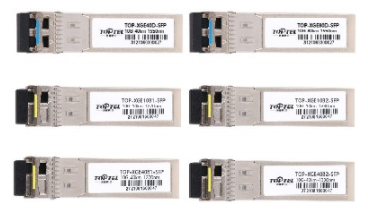
How to distinguish between single-fiber optical modules and dual-fiber optical modules?
1. Appearance:
The single-fiber optical module has one optical fiber interface, which is connected to one optical fiber; the dual-fiber optical module has two optical fiber interfaces, which are connected to two optical fibers;
2. Conventional wavelength:
The single-fiber module has two different wavelengths, and the dual-fiber module has only one wavelength;
The conventional wavelengths of single fiber mainly include the following:
Gigabit single fiber:
l TX1310/RX1550nm;
l TX1550/RX1310nm;
l TX1490/RX1550nm;
l TX1550/RX1490nm;
l TX1310nm/Rx1490nm;
l TX1490nm/Rx1310nm;
10 Gigabit single fiber:
l TX1270nm/RX1330nm
l TX1330nm/RX1270nm
l TX1490nm/RX1550nm
l TX1550nm/RX1490nm
Conventional wavelength of dual fiber: 850nm 1310nm 1550nm
1. Speed: Compared with dual-fiber optical modules, It has a wide range of applications in 100M, 1000M and 10G speeds; it is rarely used in 40G and 100G high-speed transmission; but dual-fiber modules are a poluar solution
2. For example, take 10G SFP+ single-fiber optical module and 10G SFP+ dual-fiber optical module.
Dual-fiber: Both devices at both ends use 10G SFP+ dual-fiber optical modules with a wavelength of 1310nm.
Single fiber: One end of the device uses a 1270/1330nm module, and the other end device needs to use a 1330/1270nm wavelength module.